


Developing Strategic Skills as a Business Management Consultant
- Danny Lee
- Jul 7, 2024
- 13 min read

Whether you're a seasoned Business Management Consultant, finishing year one or wondering where to start - this comprehensive guide will fill in all the gaps and take you from where you are, to where you need to be.
Jump to the bit you need 👇🏼
Building an Online Presence
Time Management and Productivity
Continuous Professional Development
Building an Online Presence
Find your niche
A niche is your little corner of knowledge.
Perhaps you have skills and experience in a particular sector, organisation or framework.
This is what sets you apart.
You dont need to be an expert in this field, just be willing to share what you know and be honest about the level of knowledge and experience you have on this topic.
Take me, for example:
I'm by no means an expert Management Systems Consultant - far from it.
What is my niche?
I spent 15 years in the Royal Air Force learning strategies and skills that give me an innate ability to build systems and procedures that not only work but are future proof - and more importantly, can survive intense pressure when catastrophic situations emerge.
Now I understand what unfair advantage I have over other Management Systems Consultants, I can look to provide information to other industries that need future proofing with systems that endure.
Choose a medium and a platform
This is fairly simple these days - there are so many options out there.
Prefer to get your information over in a written format? - Blogs!
Create a website and share everything you know about your unfair advantage:
Wix
Squarespace
WordPress
Need some help setting your website and blog up?
Drop me a message on my website and I'll run through it with you https://www.onesystemmgt.com/contact
Like the idea of sharing your little corner of knowledge by video?
Create an account with YouTube or Tik Tok, generate your first video and get it out there.
Want to jump on the trend of bringing back audio? - Podcasts!
Sign up with Spotify for Podcasters for a quick and easy way to get your first podcast online.
Content calendar
You need to post consistently in order to build an audience that anticipates you're next post, video or episode.
Building systems that remove the barriers to procrastination is the best way to achieve this.
A content calendar is a schedule that allows you to start building ideas, formulate plans and set a publish date so you can stay on track!
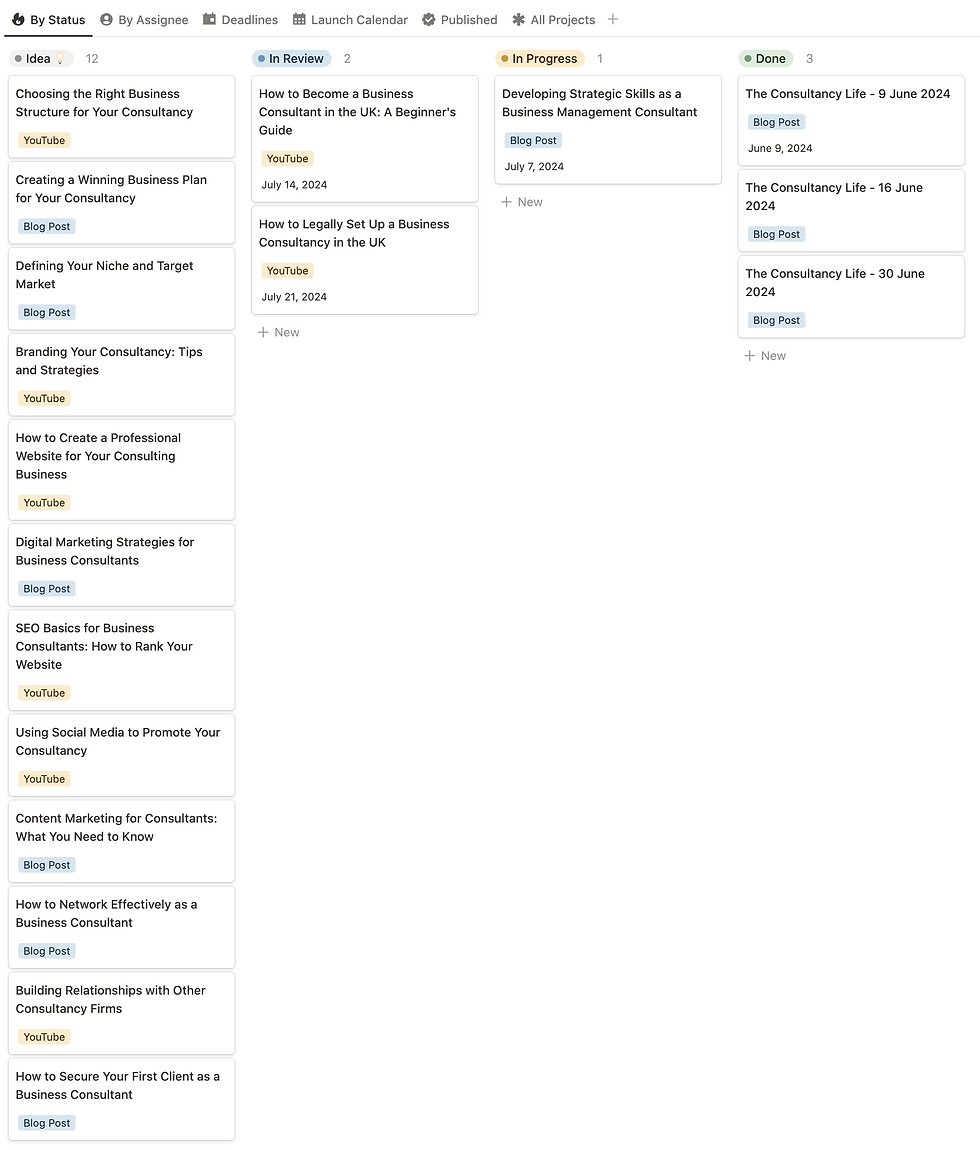
I use Notion for this task.
Notion allows me to create boards for each of my content ideas, set deadlines, decide if it will be a YouTube video or Blog post and take the guess work out of what I need to develop on a week by week basis.
Here's a snapshot of what I'm currently working on...
Search Engine Optimisation (SEO)
SEO is key to ensure the platform you have chosen picks up your content and puts in in front of the people that need to see it.
You've written a top class blog post, covered all the key topics, included lots of images, highlighted the important parts and left links to help your audience out.
You post it and...... no one sees it!
When you create your posts, you need to start with the end in mind.
What are people searching for?
Let's take the blog post you are reading right now as an example.
I know that the people I want to read this post are Business Management Consultants or those looking to break out into this line of work; that are looking to develop strategies and build on their skill sets.
If I was looking to do exactly that, I would probably search for...

Therefore, it is important to use those words, and other related words, in your blog post.
SEO is an extremely large topic and there are multi-million pound organisations out there that focus on helping businesses to improve their google search ratings...
...after all, who clicks on page 2 on google anyway...
Use keyword that your audience are likely to search in google and it will help your chances of appearing on page one of google.
I use Wix to post my blogs. They have a great SEO tool that searches your post for relevant keywords that will better help you rank higher in google searches.
I've had to learn this the hard way. My first three posts were "The Consultancy Life" followed by the date I posted it.
Who's searching for that in google?
Marketing to build a following
Once you've created your content, it's time to get it out there.
Simply posting it and hoping for the best is a sure fire way to become deflated, discouraged and unmotivated.
It's all about taking action and having a strategy.
Remember; systems and strategies.
I do it in the following way...
Step 1
Post on LinkedIn (the day before I post the blog) with a call to action to subscribe to my Blog email list...

Step 2
Generate a newsletter that can be sent to your wonderful audience - you may have even arrived on this blog after receiving my newsletter, if so, thank you!

Step 3
Repost the article on LinkedIn a few days later for those that are not subscribed and prompt them to subscribe.
Which reminds me...
Enjoy Reading My Experiences?
Consider subscribing for a free weekly update
(Don't worry, It's only once a week)
Step 4
Rinse and repeat this week in week out... for years.
Engage with audience
In a world of endless scrolling and short attention spans, receiving a comment or a like can be a sign of a really good piece of content.
Take the time to use this as an opportunity to engage with your audience. They have taken the time to stop on your post and interact - be sure to show your gratitude.
Above all, provide value
If you're only in this for the money then you're doing it all wrong.
The purpose here is to add value.
My intentions are clear.
Create articles, videos and podcasts that break down exactly what it takes to leave your 9-5 job and become a Business Management Consultant... because I wish I had someone go through all the background bits with when I was starting up.
And if that leads to someone wishing to utilise my skillset as a ISO Management Systems Consultant - then it's a win all round.
Time Management and Productivity
So you've built you content calendar, you know how to build and reach an audience and you have an idea of how to turn your audience towards your business to generate revenue.
Now, how do you fit all that in whilst carrying out your primary role - as a Business Management Consultant?
Set clear goals and objectives
You may well be familiar with the concept of SMART goals.
For those that are not - let's use building and audience as an example here.
Example 1 without SMART concept:
Build audience by creating blogs.
Now lets apply the SMART concept to improve it (click to reveal)
👈🏼 Specific
Generate a blog that focuses on tips and tricks to help aspiring Business Management Consultants to help grow an audience of like minded people
👈🏼 Measurable
I can use Wix analytics to see exactly how many people have subscribed on a week by week basis to see if my strategy is working
👈🏼 Achievable
Do I have enough time in my week to generate and post one blog? - Yes.
👈🏼 Realistic
Will posting a weekly blog contribute towards my goal of building an audience that may be interested in using my services in the future - Yes.
👈🏼 Time Bound
Post weekly to ensure I retain my current audience numbers and create a situation where it will build
Example 2 with SMART concept:
Post a weekly blog that focuses on tips and tricks to help aspiring Business Management Consultants to help grow an audience of like minded people. Use Wix analytics to ensure people are engaging with my posts and ensure my audience is growing week on week.
Which goal do you think is most likely to succeed?
Use a planner
Now you have a goal, you can build it into your already packed schedule.
Again, I use Notion to track all of my daily, weekly and monthly ongoing Projects.
Here's an example of what an entry looks like on my Notion Daily Project Tracker.

As we have already seen, keeping your system organised is just as important as completing the Consultancy Project itself.
Organisation reduces the likelihood you will miss key information, a deadline or even an overdue invoice!
Use productivity tools
There are far too many distractions in the world at the moment and if you allow it, it can be to the detriment of your business.
Fortunately, I would much rather spend time working on my business, generating new projects and documenting my journey - than I would waste time with mindless scrolling.
But what if you've hit a rut?
What if you need a way of concentrating for a period to get something over the line?
Well in this case, I would use the Pomodoro method.
Pomodoro is a time management method based on 25 minutes of focused work followed by a 5 minute break.
Now what I would suggest is that your 5 minute break isn't a quick check of your phone. Instead, I use it as an opportunity to get some steps in to contribute to my 10,000 daily steps.
Taking a little walk round the house or workplace, can help to reinvigorate the creative juices. It takes your eyes of the screen and helps you to get back in the zone.
What's the best way of doing this?
You have a few options...
Use your phone as a timer and set an alarm for 25 mins
Use a comedy egg timer - set for 25 mins

Download an app called Forest.

Forest allows you to set timers of your choice. Once you've completed your set timer, lets say 25 minutes, you are rewarded with a tree.

This tree is then added to your forest - feels like a little win and becomes addictive, building your forest.

Dedicated working spaces and boundaries
After 15 years in the RAF, having a dedicated work space in an office or aircraft hanger or... well... other places... it has been a real adjustment going from that to being in the house everyday.
So I set some clear boundaries:
1. A working day - mine is 10am - 5pm
This allows me to work with my wife to get the kids ready, do the school run if I'm not out with a client, get a run, walk or strength workout done, shower, dressed, coffee and good to go!
2. The MacBooks, iPad and iMac must remain in the office outside of my agreed working hours
I'll occasionally decide to head to the Oxfordshire countryside, find a lovely little spot to eat near the river, and get some work done. But once my work day is over, it all goes back in the office.

The Beetle & Wedge in Moulsford, South Oxfordshire
3. Overtime is ok, just don't make it a habit - no more than twice a week!
Don't get me wrong, in these early stages there is often overtime - but it's to be expected when starting a company from scratch right?
The key is to set SMART goals so it doesn't become the norm.
Important vs Urgent (Eisenhower) Matrix
A concept I have lived by for perhaps the last 10 years.

In essence, plot your task on the matrix and follow the advice:
Do it, Schedule it, Delegate it, Delete it.
Continuous Professional Development
Identify knowledge gaps
The first step to addressing your knowledge gaps is to identify them.
Perhaps this is a piece of industry software that you've yet to explore, an update to legislation that affects your profession or a skill that is stopping you from offering a product or service to your current and future clients.
Pursue formal education
There is an abundance of information available out there. Almost everything that can be, and is taught, in a classroom can be found online.
There are two potential issues with doing the research yourself:
1. It takes a lot of time
Firstly, if you have a gap in knowledge, do you know the right questions to ask to find the information you need?
If you're running your own business, and dealing with everything that comes with it, do you have the time to root around the internet to find everything you need?
2. You're left with no formal qualification
Now in a lot of cases this may not be an issue. However, formal certificates from professional bodies can add real credibility to your education. It may be the difference between gaining a client and not... something to consider.
In my own situation, I have achieved Lead Auditor qualifications in both Quality and Environmental Management Systems with the International Register of Certified Auditors (IRCA) and the Chartered Quality Institute (CQI).
I have also achieved Lean Six Sigma (Green Belt) status with the Lean Six Sigma Company.
My pursuit for formal education has led me to consider:
Level 5 qualification in Professional Consulting with the Chartered Management Institute (CMI)
Level 6 qualification in Security Risk Management Consultancy with the Awards for Training and Higher Education (ATHE)
Obtaining professional status with an institute can go along way to cementing your credibility as a professional in your industry. There are usually fees associated but if you get yourself out there, they should pay for themselves.
There may also be other benefits included in your membership such as access to webinars and seminars, videos that break down helpful tips from experts in your field, newsletters, magazines and access to mentors.
Attend workshops, seminars and webinars
Not only will you gain invaluable insight to industry standards and practices, you have the unique opportunity to network with likeminded people - perhaps even industry experts!
At first, this can be daunting.
Networking not only has the benefit of connecting you with people that can help you, and hopefully you can help, but it increases your surface area for business opportunities.
For those that have kept up to date with my recent posts, you'll know that I attended a seminar at The Shard, London, listening to two ISO Consultancy companies and an ISO Certification Body discussing the benefits of introducing ISO 27001 (Information Security) into organisations across the UK.
Although this is not my area of expertise, I used the opportunity to network.
As a result, I landed a contract with a consultancy company - You can read all about my tips and tricks for networking at The Shard here - https://www.onesystemmgt.com/post/the-consultancy-life-16-june-2024
Webinars are also extremely effective.
In the very very early stages of deciding to start my own business, I was fortunate enough to be invited to the UK Consulting webinar which included industry experts and large business owners sharing information and best practices.
Again, as I had nothing to offer, I used this as an opportunity to network.
I asked very simple questions that focused on what a beginner consultant should consider when starting out. With all the experience in the "room" it's safe to say that this 1 hour dial in lead me to where I am now.
Get out of that comfort zone... there's nothing productive happening in there.
Online learning platforms
In the event you want to pursue education informally, there are some great course platforms out there -
Udemy
LinkedIn Learning
Skillshare
Brilliant
These platforms are relatively inexpensive, a great investment in yourself and often come with free trial periods.
Absorb information
Our time is constantly being pulled from both internal and external sources. Sometimes you may need to combine tasks to fit it all in.
How do I do it?
As you know, my work day starts at 10am which allows me to get my exercise done before I send my first email.
Very often, I'll listen to a podcast or audiobook relevant to what it is I'm trying to achieve that given week.
Not only does it allow me to push the pace on my run - without realising how close to passing out I actually am - but it also gets my creative juices going ready for when I do get round to sending that first email.
On the days when I'm with a client, I'll use the commute in the car or the ride on the train to do precisely the same.
Something to consider before you become a multitasking beast, however, is that there's a time and a place for this.
Sometimes a nice walk in a park in the Cotswolds is all it needs to be... though my mind turns straight to business - another benefit of getting those 10,000 steps in each day.
What am I listening to at the moment?
1. Deep Dive with Ali Abdaal (everything productivity)
2. Think Faster, Talk Smarter (public speaking)
3. The Economist Podcast (keeping up to date on financial business and opportunities)
4. The Times News Briefing (Daily News three times a day, less than 5 mins a time)
5. Exploring Standards with Assent (expert updates in the world of ISO Consultancy)
What am I reading at the moment?
1. Show your work - Austin Kleon (a guide to documenting your professional journey)
2. Million Dollar Weekend - Noah Kagan (how to generate ideas and take action)
3. The Gruffalo (effective ways to get a 4 year old to sleep... it's not working - help!)
Side note, Noah Kagan was the 30th person to be hired by Mark Zuckerburg at Facebook. His eventual sacking lead him to create a $100M business. I liked his work so reached out to him on LinkedIn and got a reply...


Get out of your comfort zone. Do what needs to be done. Make those connections.
Seek mentorship and coaching
This is something I firmly believe.
You can't do it all on your own.
I have been fortunate enough in my RAF career to be promoted several times and become a Senior Manager.
This means working with a whole host of dfferent teams at all levels within an organisation.
One of the most satisfying and rewarding roles were opportunities when I could provide mentorship and guidance to my teams, colleagues and superiors (yes, even they need your advice when you're the expert).
So for me this was a no brainer.
As soon as I achieved my professional status with the Chartered Quality Institute, I jumped onboard their mentor program.
The program connects individuals looking to advance their professional career (me) with experts in your chosen field (My mentor - Blake).
Blake has been exceptional.
He has broken down the myths, cast aside my fears, and helped develop strategies that will see my company thrive.
He also has extremely valuable contacts that have already borne fruit.
Finding a mentor who resonates with your own strategic direction can be the difference between success and stagnation.
I was incredibly fortunate to strike gold with my mentor on the first try.
Blake, if you're reading this, you've helped more than you know.
Find someone a decade ahead of you
This is hard to do, but it is the most effective strategy for professional growth.
Finding a company that provides the same service you do (and more!) but is a decade or more ahead of you has all sorts of untapped potential.
The hard part is convincing them to allow you into their circle, after all, in the world of business, you are competition, right?
If you've had the same idea but are struggling to get the help you need, here are my tips:
1. Be vulnerable and completely honest
2. Express upfront what you are trying to achieve
3. Once they let you in, go above and beyond to repay them for their kindness
4. Never... Ever... break their trust
If you get this right, you become part of their family.
Loyalty is everything here - there are some truly incredible people out there.
Another Week Down!
Thank you if you made it this far!
If you did, please consider leaving a message below or subscribing for a free weekly update
✌🏼
Did You Find This Post Useful?
Yes
No



Great blog this week Danny! Learnt a lot and need to implement 25:5 into my own role instead of hyperfixating and sitting for hours.
However, book 4 of your reading list is missing… Twilight!